


Floyd Teter

Watching the current trends and future direction of Oracle's Applicationsfteterhttp://www.blogger.com/profile/11221041028141787708noreply@blogger.comBlogger464125
Updated: 1 week 5 days ago
Tech and Social Isolation
We're living through some uncertain times these days. I keep trying to draw historical parallels in the hope of finding some pearls of wisdom for dealing with COVID-19...
As a very young boy, I can remember stories from my grandparents about living through the Spanish Flu epidemic from 1918 to 1920. And I can’t help but draw parallels with today’s COVID-19 pandemic, especially the social isolation required to combat the spread of both viruses. But I also contemplate the one huge difference: today’s ability to use technology to keep work going, help others and to keep in contact with those we care about. Some examples:
I’m not sure how those folks back in 1918 survived the separation with their sanity, but I am certainly grateful for the blessings technology brings in the face of today’s social distancing!
Tell us how you're using tech to keep things going while sheltering in place. The comments await!
As a very young boy, I can remember stories from my grandparents about living through the Spanish Flu epidemic from 1918 to 1920. And I can’t help but draw parallels with today’s COVID-19 pandemic, especially the social isolation required to combat the spread of both viruses. But I also contemplate the one huge difference: today’s ability to use technology to keep work going, help others and to keep in contact with those we care about. Some examples:
- Even with three-quarters of the world’s population under shelter-at-home directives, we’re still able to deliver Office Hours for Responsive UX to audiences averaging roughly 200 attendees. Even better, many Oracle customers are making the switch while their entire workforce is working remotely.
- My wife is building and donating effective respiratory masks. After researching the material 3M uses to make their N95 masks, Marlene developed a mask pattern for full facial respiratory masks. She cuts the masks (made entirely out of the N95 filter material) on her Silhouette Cameo 4 (a programmable material cutter) in bulk and then sews on the elastic straps. She has provided masks to family, friends, health-care providers, law enforcement and local hospitals. And she has also provided kits with cut material, elastic bands, and instructions for those who can sew.
- A close friend's family celebrates Easter, typically by gathering for an Easter feast. This year, they all cooked at home and gathered via Google Duo for a virtual family feast. A gathering made possible by technology.
I’m not sure how those folks back in 1918 survived the separation with their sanity, but I am certainly grateful for the blessings technology brings in the face of today’s social distancing!
Tell us how you're using tech to keep things going while sheltering in place. The comments await!
Working From Home
Things being what they are in today's challenging and uncertain world, many of us are working from home. For some of us, this is a new experience that can be tough to figure out. Fortunately, tech give us the opportunity to work from home and keep business moving.
I've personally had the good fortune to work primarily from home for the past several years, so I thought it might be helpful to share some tips that have worked for me to make working from home very successful.
Have A Dedicated Workspace In Your Home
Set Ground Rules In Your Home
Make Sure You Have Bandwidth
Get Out Of Your Pajamas
That's right. Get out of bed and change out of your pajamas. It helps get your mind in gear for work. I'm not suggesting a suit or formal business attire. I am suggesting business casual, just to remind yourself that you're working.
Don't Sweat The Background Noise
Take Breaks
Stay Connected
Start The Day With A "To Do" List
Make Sure Your Web Conference Apps Work
The World Looks Worse Through A Screen
Be Uplifted Every Day
I've personally had the good fortune to work primarily from home for the past several years, so I thought it might be helpful to share some tips that have worked for me to make working from home very successful.
Have A Dedicated Workspace In Your Home
Some of us are fortunate to have a guest room or other spare room to turn into a home office and effective workspace. Others may be limited to a corner of a kitchen, living room, or bedroom. Do what you can, but do have a space dedicated as your work area.
If you share your home with others - roommates, significant others, children, other family members - set some ground rules to be followed while you're working from home. The fact that you are home does not necessarily mean you are available to them. You can't run to the grocery store, provide transportation, or run personal errands at the drop of a hat. And they need to know that.
This also means setting boundaries on work. It's easy for work to bleed over into your personal life when working from home. So one of those ground rules should be an agreement on when you'll set work aside and be available for those with whom you share your home.
Do you have broadband internet access? If not, get it immediately. Working from home using your phone as a wifi hotspot for connectivity is not going to cut it. And be sure you set hours for others in the house to be online for entertainment - nothing will cause more frustration than having your web conference audio drop out because someone in the family consuming bandwidth watching Hulu.
Don't Sweat The Background Noise
Look, many of us are working from home with plenty of background noise: significant others (who may also be working from home), children out of school, pets, doorbells, etc. We're all dealing with it, we all get it, so don't sweat it.
While you may be self-isolating or under a "shelter in place" order, but it's still possible to take breaks. Walk away for a few minutes. Go outside and soak up a little sunshine. Or spend a few minutes on a quick workout. Then come back to work refreshed and reinvigorated.
Stay connected to the folks you work with. IM, Slack, txt... whatever works for you. Staying connected will eliminate the feelings of isolation and will also keep you engaged in the work that still needs doing.
Be sure you have a list of things that you intend to accomplish today. And have that list ready and visible when you start the day's work. Now if you're anything like me, the day never goes the way you plan. That's OK - don't beat yourself up if some of those things don't get done. Just carry them over to tomorrow's list. The point is to begin the day with a purpose in mind.
You'll find that you spend much of your work-at-home days on Zoom, WebEx, Microsoft Teams and other web apps. Personally, I find myself using all of those apps - and others - in the course of a normal day. So take a few minutes once a week or so to make sure they're all updated and in working order.
When you're isolated from others, the world always looks worse through a screen - phone, computer, tablet, TV, whatever. It's easy to get caught up in the furor when you're outside your network. So take what you see on that screen with a grain of salt.
Allow something into your life that uplifts you every day. For me, it's classical music played from XM/Sirius Radio. Sometimes it's checking the headlines at the Good News Network (an exception to "The World Looks Worse Through A Screen" concept). For you, it may be a brief stroll in the sunshine or taking a few minutes with an audio book. The point is to find something that makes you feel better and make time for it every day.
I've always enjoyed working from home. Frankly, I'm much more productive in my home office than anywhere else. And you may now have an opportunity to discover the same holds true for you. For others, you'll find that you would rather be in the office. For those in the latter category, keep in mind that this situation will pass. So embrace this, for however long it lasts.
If you have tips for working from home, please do share in the comments. Let's learn from each other!
When Less Is Best
Late in 2019, Apple obsoleted my trusty iPad Mini II. No more OS updates, may not run the latest apps, etc. So I figured it was time for a new iPad... right up until the time I saw the prices. Yikes!!!
The expense of a new iPad, even a Mini, made me step back and reconsider my approach. I started by considering my uses of the iPad. I don't really create much with an iPad - it's just too limited for the type of work I do. And I don't communicate much with it, as I have an iPhone for calls, txt, and video chats. I use my iPad to consume: books, movies, social media and news.
Once I understood my own use cases for the iPad, I realized I could fill my needs with a much less expensive device. I settled on an Amazon Fire HD 8 (thanks to my kids for the nifty Christmas present). And it works great for what I do, especially after setting it up to side load from Google Play. My old Mini has been retired to a life as a digital photo frame and I'm really happy with the Fire. Is the Fire as elegant of an experience as the Mini? Not by a long shot. But it gets the job done quite well. And, at last check, the Fire is about 20% of the price of a new iPad Mini. A great example of less being best.
I see this quite a bit in the way users work with enterprise applications - in my specific case, observations are from helping customers with Oracle HCM Cloud Enterprise Applications. Users expend significant costs in terms of time and labor facilitating some very complicated use cases, many of which are either unnecessary or rarely encountered. When we collaborate with those customers on those use cases, the end result is often that less is best. Often they're focused on a specific use case because they have not considered another process for getting the job done. Other times it's a matter of the use case not being as critical to the business as originally thought. And sometimes it's due to a legal or industry requirement that no longer exists. And there are many more causes. But it always makes my day when the lightbulb comes on and people realize they can make do quite well with much less than they originally thought.
I've seen this surface frequently in working with customers on the mobile-enabled Responsive UX. Simplification was a driving design concept in building out Responsive UX, which means some less used and less important features were culled from the product. Less is best, based on the feedback we've received from customers who have adopted the new UX.
So the upshot here? Step back, take a breath, and think about how you use your enterprise apps. Can you find instances where less would be best? I'll bet you find more than one.
The expense of a new iPad, even a Mini, made me step back and reconsider my approach. I started by considering my uses of the iPad. I don't really create much with an iPad - it's just too limited for the type of work I do. And I don't communicate much with it, as I have an iPhone for calls, txt, and video chats. I use my iPad to consume: books, movies, social media and news.
Once I understood my own use cases for the iPad, I realized I could fill my needs with a much less expensive device. I settled on an Amazon Fire HD 8 (thanks to my kids for the nifty Christmas present). And it works great for what I do, especially after setting it up to side load from Google Play. My old Mini has been retired to a life as a digital photo frame and I'm really happy with the Fire. Is the Fire as elegant of an experience as the Mini? Not by a long shot. But it gets the job done quite well. And, at last check, the Fire is about 20% of the price of a new iPad Mini. A great example of less being best.
I see this quite a bit in the way users work with enterprise applications - in my specific case, observations are from helping customers with Oracle HCM Cloud Enterprise Applications. Users expend significant costs in terms of time and labor facilitating some very complicated use cases, many of which are either unnecessary or rarely encountered. When we collaborate with those customers on those use cases, the end result is often that less is best. Often they're focused on a specific use case because they have not considered another process for getting the job done. Other times it's a matter of the use case not being as critical to the business as originally thought. And sometimes it's due to a legal or industry requirement that no longer exists. And there are many more causes. But it always makes my day when the lightbulb comes on and people realize they can make do quite well with much less than they originally thought.
I've seen this surface frequently in working with customers on the mobile-enabled Responsive UX. Simplification was a driving design concept in building out Responsive UX, which means some less used and less important features were culled from the product. Less is best, based on the feedback we've received from customers who have adopted the new UX.
So the upshot here? Step back, take a breath, and think about how you use your enterprise apps. Can you find instances where less would be best? I'll bet you find more than one.
Blowing Out Barriers
I was chatting with a new friend last weekend. Turns out we're both in the enterprise apps business: I work for Oracle on HCM Cloud apps while he works at a small start-up building and selling a warehouse management system.
While we were chatting about the biz, we got into SaaS and Cloud. My friend made a statement I really want to share: "Cloud blew out all our barriers to entering this marketplace; we wouldn't be in business without Cloud." When I pressed him on this, he made the following points:
While we were chatting about the biz, we got into SaaS and Cloud. My friend made a statement I really want to share: "Cloud blew out all our barriers to entering this marketplace; we wouldn't be in business without Cloud." When I pressed him on this, he made the following points:
- Our entire development platform is cloud-based; no on-prem servers whatsoever
- We track our bugs and manage our development cycles with JIRA
- All our accounting, HR, and sales apps are SaaS with providers focused on SMB customers
- We don't even have internal email - we have a Slack channel
- Our product is SaaS-based and runs on two IaaS partner platforms. Our SMB customers would not be able to afford the infrastructure required to run on prem.
- Most of our user documentation is visual and chart-based. Our off-shore team uses LucidChart to build that stuff.
I walked away from the conversation thinking: "Isn't this cool? These guys have leveraged the cloud to build a product startup about to break into 9-digit revenue (in U.S. dollars) with zero infrastructure. These guys get it."
This has always been the promise of the Cloud: do business without large capital investments. It was just neat to experience yet another example of this promise fulfilled IRL.
Tell me again why you're running on-prem enterprise apps?
I See Systems
Working in enterprise software has changed my perspective on the world around me... I see everything through more of a systemic lens.
My wife recently had knee replacement surgery. World-renown surgeon performing the surgery. But being done at his 2nd choice of hospitals due to limitations of our health insurance policy. Good hospital, but not his hospital of choice. Like everything else involving health care in the U.S., it's a money thing.
The surgery was originally scheduled for Friday, December 13th but postponed until Monday, December 16th. On the 16th, we were requested to arrive at the hospital at 11 am for a planned surgery of 1 pm. But the surgery did not begin until 6 pm. At this point, I'm thinking that these guys have no idea about linear programming and managing their supply chain.
While my wife was in surgery, I was directed to a "Surgery Waiting Room". The room allegedly had an attendant and a television screen for monitoring patient status during surgery. When I entered the waiting room, I immediately noticed the attendant's desk was unoccupied. Seems that the attendant's shift ends at 5 pm - those waiting on surgeries beyond 5 pm are asked to answer the phones on a volunteer basis. The idea being that surgical staff will call the waiting room to update family and friends when surgery is completed, and to alert those waiting that the surgeon is on the way up with a more detailed debrief. So, being the volunteering type, I sit at the attendant's desk and start answering the phone. After about three incoming calls, I notice a trend - no friends or family in the room to receive the updates. And I'm also noticing surgeons coming into the room looking for friends and family who are not there. I put the phone to use and make a few inquiries within the hospital - and discover that there are three surgery waiting rooms in this tower alone (the hospital in question has seven towers). Neither the surgical staff nor the surgeons have any idea which waiting room contains friends and family for any particular patient, as they have no waiting room check-in function. So they're literally hunting for the pea under any one of three shells as they go from waiting room to waiting room searching for friends and family of a particular patient. Low-key chaos.
Another observation from the surgical waiting room: the status screen showing patient status is listed by case number rather than patient name. I did not have a case number for my wife's surgery. And a quick survey of the folks in the waiting room indicated that none of them had a case number either. So the status screen was useless to those of us waiting on surgical outcomes. During the next few incoming calls from surgical staff, I asked for case numbers. But the surgical staff had no idea of the case numbers either. What in the world?
Fortunately, the surgery went well, the outcome was positive, and Marlene is now home working through the long recovery process.
After rolling the surgical experience over in my head, I decided to view this experience as a systemic failure for this particular hospital. Lots of good people with lots of energy all trying to do the right thing, but nobody has tied it all together. So how might I suggest improving things from a system point of view?
First, I'd establish personas: the patient, the family member/friend of the patient, the surgical staff member, the attendant, the pre-op nurse, the surgeon, and so on. Then I'd walk through the entire process, from the time a patient walks in the door until they leave post-op recovery. And I'd do it for each persona. Essentially build a systemic "As Is" flow. Then design how we want things to work, review the changes with the people doing the work, then implement.
Sounds a bit like an enterprise applications implementation project, doesn't it? Well, enterprise applications are all about implementing systems. Like I said, working in enterprise software has changed my perspective of the world around me...
How about you? Ever have a similar experience? Healthcare? The DMV? Retail returns? Sound off in the comments about your experience and how you'd approach a fix.
My wife recently had knee replacement surgery. World-renown surgeon performing the surgery. But being done at his 2nd choice of hospitals due to limitations of our health insurance policy. Good hospital, but not his hospital of choice. Like everything else involving health care in the U.S., it's a money thing.
The surgery was originally scheduled for Friday, December 13th but postponed until Monday, December 16th. On the 16th, we were requested to arrive at the hospital at 11 am for a planned surgery of 1 pm. But the surgery did not begin until 6 pm. At this point, I'm thinking that these guys have no idea about linear programming and managing their supply chain.
While my wife was in surgery, I was directed to a "Surgery Waiting Room". The room allegedly had an attendant and a television screen for monitoring patient status during surgery. When I entered the waiting room, I immediately noticed the attendant's desk was unoccupied. Seems that the attendant's shift ends at 5 pm - those waiting on surgeries beyond 5 pm are asked to answer the phones on a volunteer basis. The idea being that surgical staff will call the waiting room to update family and friends when surgery is completed, and to alert those waiting that the surgeon is on the way up with a more detailed debrief. So, being the volunteering type, I sit at the attendant's desk and start answering the phone. After about three incoming calls, I notice a trend - no friends or family in the room to receive the updates. And I'm also noticing surgeons coming into the room looking for friends and family who are not there. I put the phone to use and make a few inquiries within the hospital - and discover that there are three surgery waiting rooms in this tower alone (the hospital in question has seven towers). Neither the surgical staff nor the surgeons have any idea which waiting room contains friends and family for any particular patient, as they have no waiting room check-in function. So they're literally hunting for the pea under any one of three shells as they go from waiting room to waiting room searching for friends and family of a particular patient. Low-key chaos.
Another observation from the surgical waiting room: the status screen showing patient status is listed by case number rather than patient name. I did not have a case number for my wife's surgery. And a quick survey of the folks in the waiting room indicated that none of them had a case number either. So the status screen was useless to those of us waiting on surgical outcomes. During the next few incoming calls from surgical staff, I asked for case numbers. But the surgical staff had no idea of the case numbers either. What in the world?
Fortunately, the surgery went well, the outcome was positive, and Marlene is now home working through the long recovery process.
After rolling the surgical experience over in my head, I decided to view this experience as a systemic failure for this particular hospital. Lots of good people with lots of energy all trying to do the right thing, but nobody has tied it all together. So how might I suggest improving things from a system point of view?
First, I'd establish personas: the patient, the family member/friend of the patient, the surgical staff member, the attendant, the pre-op nurse, the surgeon, and so on. Then I'd walk through the entire process, from the time a patient walks in the door until they leave post-op recovery. And I'd do it for each persona. Essentially build a systemic "As Is" flow. Then design how we want things to work, review the changes with the people doing the work, then implement.
Sounds a bit like an enterprise applications implementation project, doesn't it? Well, enterprise applications are all about implementing systems. Like I said, working in enterprise software has changed my perspective of the world around me...
How about you? Ever have a similar experience? Healthcare? The DMV? Retail returns? Sound off in the comments about your experience and how you'd approach a fix.
I See Systems
Working in enterprise software has changed my perspective on the world around me... I see everything through more of a systemic lens.
My wife recently had knee replacement surgery. World-renown surgeon performing the surgery. But being done at his 2nd choice of hospitals due to limitations of our health insurance policy. Good hospital, but not his hospital of choice. Like everything else involving health care in the U.S., it's a money thing.
The surgery was originally scheduled for Friday, December 13th but postponed until Monday, December 16th. On the 16th, we were requested to arrive at the hospital at 11 am for a planned surgery of 1 pm. But the surgery did not begin until 6 pm. At this point, I'm thinking that these guys have no idea about linear programming and managing their supply chain.
While my wife was in surgery, I was directed to a "Surgery Waiting Room". The room allegedly had an attendant and a television screen for monitoring patient status during surgery. When I entered the waiting room, I immediately noticed the attendant's desk was unoccupied. Seems that the attendant's shift ends at 5 pm - those waiting on surgeries beyond 5 pm are asked to answer the phones on a volunteer basis. The idea being that surgical staff will call the waiting room to update family and friends when surgery is completed, and to alert those waiting that the surgeon is on the way up with a more detailed debrief. So, being the volunteering type, I sit at the attendant's desk and start answering the phone. After about three incoming calls, I notice a trend - no friends or family in the room to receive the updates. And I'm also noticing surgeons coming into the room looking for friends and family who are not there. I put the phone to use and make a few inquiries within the hospital - and discover that there are three surgery waiting rooms in this tower alone (the hospital in question has seven towers). Neither the surgical staff nor the surgeons have any idea which waiting room contains friends and family for any particular patient, as they have no waiting room check-in function. So they're literally hunting for the pea under any one of three shells as they go from waiting room to waiting room searching for friends and family of a particular patient. Low-key chaos.
Another observation from the surgical waiting room: the status screen showing patient status is listed by case number rather than patient name. I did not have a case number for my wife's surgery. And a quick survey of the folks in the waiting room indicated that none of them had a case number either. So the status screen was useless to those of us waiting on surgical outcomes. During the next few incoming calls from surgical staff, I asked for case numbers. But the surgical staff had no idea of the case numbers either. What in the world?
Fortunately, the surgery went well, the outcome was positive, and Marlene is now home working through the long recovery process.
After rolling the surgical experience over in my head, I decided to view this experience as a systemic failure for this particular hospital. Lots of good people with lots of energy all trying to do the right thing, but nobody has tied it all together. So how might I suggest improving things from a system point of view?
First, I'd establish personas: the patient, the family member/friend of the patient, the surgical staff member, the attendant, the pre-op nurse, the surgeon, and so on. Then I'd walk through the entire process, from the time a patient walks in the door until they leave post-op recovery. And I'd do it for each persona. Essentially build a systemic "As Is" flow. Then design how we want things to work, review the changes with the people doing the work, then implement.
Sounds a bit like an enterprise applications implementation project, doesn't it? Well, enterprise applications are all about implementing systems. Like I said, working in enterprise software has changed my perspective of the world around me...
How about you? Ever have a similar experience? Healthcare? The DMV? Retail returns? Sound off in the comments about your experience and how you'd approach a fix.
My wife recently had knee replacement surgery. World-renown surgeon performing the surgery. But being done at his 2nd choice of hospitals due to limitations of our health insurance policy. Good hospital, but not his hospital of choice. Like everything else involving health care in the U.S., it's a money thing.
The surgery was originally scheduled for Friday, December 13th but postponed until Monday, December 16th. On the 16th, we were requested to arrive at the hospital at 11 am for a planned surgery of 1 pm. But the surgery did not begin until 6 pm. At this point, I'm thinking that these guys have no idea about linear programming and managing their supply chain.
While my wife was in surgery, I was directed to a "Surgery Waiting Room". The room allegedly had an attendant and a television screen for monitoring patient status during surgery. When I entered the waiting room, I immediately noticed the attendant's desk was unoccupied. Seems that the attendant's shift ends at 5 pm - those waiting on surgeries beyond 5 pm are asked to answer the phones on a volunteer basis. The idea being that surgical staff will call the waiting room to update family and friends when surgery is completed, and to alert those waiting that the surgeon is on the way up with a more detailed debrief. So, being the volunteering type, I sit at the attendant's desk and start answering the phone. After about three incoming calls, I notice a trend - no friends or family in the room to receive the updates. And I'm also noticing surgeons coming into the room looking for friends and family who are not there. I put the phone to use and make a few inquiries within the hospital - and discover that there are three surgery waiting rooms in this tower alone (the hospital in question has seven towers). Neither the surgical staff nor the surgeons have any idea which waiting room contains friends and family for any particular patient, as they have no waiting room check-in function. So they're literally hunting for the pea under any one of three shells as they go from waiting room to waiting room searching for friends and family of a particular patient. Low-key chaos.
Another observation from the surgical waiting room: the status screen showing patient status is listed by case number rather than patient name. I did not have a case number for my wife's surgery. And a quick survey of the folks in the waiting room indicated that none of them had a case number either. So the status screen was useless to those of us waiting on surgical outcomes. During the next few incoming calls from surgical staff, I asked for case numbers. But the surgical staff had no idea of the case numbers either. What in the world?
Fortunately, the surgery went well, the outcome was positive, and Marlene is now home working through the long recovery process.
After rolling the surgical experience over in my head, I decided to view this experience as a systemic failure for this particular hospital. Lots of good people with lots of energy all trying to do the right thing, but nobody has tied it all together. So how might I suggest improving things from a system point of view?
First, I'd establish personas: the patient, the family member/friend of the patient, the surgical staff member, the attendant, the pre-op nurse, the surgeon, and so on. Then I'd walk through the entire process, from the time a patient walks in the door until they leave post-op recovery. And I'd do it for each persona. Essentially build a systemic "As Is" flow. Then design how we want things to work, review the changes with the people doing the work, then implement.
Sounds a bit like an enterprise applications implementation project, doesn't it? Well, enterprise applications are all about implementing systems. Like I said, working in enterprise software has changed my perspective of the world around me...
How about you? Ever have a similar experience? Healthcare? The DMV? Retail returns? Sound off in the comments about your experience and how you'd approach a fix.
Changing Up On BYOT
So if you're tired of the same old story,
Oh, turn some pages
I will be here when you are ready
To roll with the changes, yeah, yeah
- From REO Speedwagon's "Roll With The Changes"
It's a bit of a milestone for my employment with Oracle today. For the past 7 or so years, I've been a "Bring Your Own Toolbox" (aka "BYOT") kind of guy: my own laptop, my preferred software applications, my library of virtual machines, my setup of development tools, etc. That's mainly because I could get better results faster with my own toolbox than with the tools my employer provided. An example of this is the Toshiba Tecra laptop running Windows 7 that I was issued at the start of my current employment. It's made for a fine doorstop, but not much else.
My approach changed today. I have a spiffy, brand-new MacBook Pro provisioned and configured by Oracle. In fact, I'm writing this post on that very machine.
When Oracle offered the MacBook Pro, I decided to give it a try because it's a superior hardware platform to my MacBook Air. Better hardware performance was the enticement. I was even willing to put up with the inconvenience of accommodating the USB-C ports (4 of those and a headphone jack are all you get on the 2019 MacBook Pro).
On the downside, I no longer entirely control the configuration of my work platform. For one thing, I'm not a big fan of McAfee Endpoint Security for macOS due to the performance suck. And I can't run Little Snitch on the Pro to see what services and connects are active. So I'm a little concerned about the impact to my productivity. And that's why I still have my own work platform running in my office right next to the new MacBook Pro ;)
As I've said in the past, I really believe in the BYOT approach. So this will be an interesting test as to whether or not that approach makes sense in this situation, especially in an "all cloud all the time" world. I'll check in here every once in awhile to let y'all know how it's going.
In the meantime, how do you approach this? Do you bring your own tools and devices to your job? Or do you make do with what your employer gives you? Why have you made the choice you've made? Share your thoughts in the comments.
Oh, turn some pages
I will be here when you are ready
To roll with the changes, yeah, yeah
- From REO Speedwagon's "Roll With The Changes"
It's a bit of a milestone for my employment with Oracle today. For the past 7 or so years, I've been a "Bring Your Own Toolbox" (aka "BYOT") kind of guy: my own laptop, my preferred software applications, my library of virtual machines, my setup of development tools, etc. That's mainly because I could get better results faster with my own toolbox than with the tools my employer provided. An example of this is the Toshiba Tecra laptop running Windows 7 that I was issued at the start of my current employment. It's made for a fine doorstop, but not much else.
My approach changed today. I have a spiffy, brand-new MacBook Pro provisioned and configured by Oracle. In fact, I'm writing this post on that very machine.
When Oracle offered the MacBook Pro, I decided to give it a try because it's a superior hardware platform to my MacBook Air. Better hardware performance was the enticement. I was even willing to put up with the inconvenience of accommodating the USB-C ports (4 of those and a headphone jack are all you get on the 2019 MacBook Pro).
On the downside, I no longer entirely control the configuration of my work platform. For one thing, I'm not a big fan of McAfee Endpoint Security for macOS due to the performance suck. And I can't run Little Snitch on the Pro to see what services and connects are active. So I'm a little concerned about the impact to my productivity. And that's why I still have my own work platform running in my office right next to the new MacBook Pro ;)
As I've said in the past, I really believe in the BYOT approach. So this will be an interesting test as to whether or not that approach makes sense in this situation, especially in an "all cloud all the time" world. I'll check in here every once in awhile to let y'all know how it's going.
In the meantime, how do you approach this? Do you bring your own tools and devices to your job? Or do you make do with what your employer gives you? Why have you made the choice you've made? Share your thoughts in the comments.
Changing Up On BYOT
So if you're tired of the same old story,
Oh, turn some pages
I will be here when you are ready
To roll with the changes, yeah, yeah
- From REO Speedwagon's "Roll With The Changes"
It's a bit of a milestone for my employment with Oracle today. For the past 7 or so years, I've been a "Bring Your Own Toolbox" (aka "BYOT") kind of guy: my own laptop, my preferred software applications, my library of virtual machines, my setup of development tools, etc. That's mainly because I could get better results faster with my own toolbox than with the tools my employer provided. An example of this is the Toshiba Tecra laptop running Windows 7 that I was issued at the start of my current employment. It's made for a fine doorstop, but not much else.
My approach changed today. I have a spiffy, brand-new MacBook Pro provisioned and configured by Oracle. In fact, I'm writing this post on that very machine.
When Oracle offered the MacBook Pro, I decided to give it a try because it's a superior hardware platform to my MacBook Air. Better hardware performance was the enticement. I was even willing to put up with the inconvenience of accommodating the USB-C ports (4 of those and a headphone jack are all you get on the 2019 MacBook Pro).
On the downside, I no longer entirely control the configuration of my work platform. For one thing, I'm not a big fan of McAfee Endpoint Security for macOS due to the performance suck. And I can't run Little Snitch on the Pro to see what services and connects are active. So I'm a little concerned about the impact to my productivity. And that's why I still have my own work platform running in my office right next to the new MacBook Pro ;)
As I've said in the past, I really believe in the BYOT approach. So this will be an interesting test as to whether or not that approach makes sense in this situation, especially in an "all cloud all the time" world. I'll check in here every once in awhile to let y'all know how it's going.
In the meantime, how do you approach this? Do you bring your own tools and devices to your job? Or do you make do with what your employer gives you? Why have you made the choice you've made? Share your thoughts in the comments.
Oh, turn some pages
I will be here when you are ready
To roll with the changes, yeah, yeah
- From REO Speedwagon's "Roll With The Changes"
It's a bit of a milestone for my employment with Oracle today. For the past 7 or so years, I've been a "Bring Your Own Toolbox" (aka "BYOT") kind of guy: my own laptop, my preferred software applications, my library of virtual machines, my setup of development tools, etc. That's mainly because I could get better results faster with my own toolbox than with the tools my employer provided. An example of this is the Toshiba Tecra laptop running Windows 7 that I was issued at the start of my current employment. It's made for a fine doorstop, but not much else.
My approach changed today. I have a spiffy, brand-new MacBook Pro provisioned and configured by Oracle. In fact, I'm writing this post on that very machine.
When Oracle offered the MacBook Pro, I decided to give it a try because it's a superior hardware platform to my MacBook Air. Better hardware performance was the enticement. I was even willing to put up with the inconvenience of accommodating the USB-C ports (4 of those and a headphone jack are all you get on the 2019 MacBook Pro).
On the downside, I no longer entirely control the configuration of my work platform. For one thing, I'm not a big fan of McAfee Endpoint Security for macOS due to the performance suck. And I can't run Little Snitch on the Pro to see what services and connects are active. So I'm a little concerned about the impact to my productivity. And that's why I still have my own work platform running in my office right next to the new MacBook Pro ;)
As I've said in the past, I really believe in the BYOT approach. So this will be an interesting test as to whether or not that approach makes sense in this situation, especially in an "all cloud all the time" world. I'll check in here every once in awhile to let y'all know how it's going.
In the meantime, how do you approach this? Do you bring your own tools and devices to your job? Or do you make do with what your employer gives you? Why have you made the choice you've made? Share your thoughts in the comments.
What Looks Good To Me: Oracle OpenWorld 2019
As I write this, we're a week away from Oracle OpenWorld 2019. And, as always at OOW, there are a flood of sessions, events and gatherings that compete for your attention. So I thought I'd share some thoughts on what looks good to me. Keep in mind that my current focus is Oracle HCM Cloud Applications, so I'll be limiting my shared thoughts to that subject area.
Needless to say, the executive keynotes and the HCM Cloud Roadmap sessions are high points. For the most part, I won't be calling those out here even though I personally plan to make as many as I can.
For starters, note that I'll be hosting or co-hosting several sessions myself:

You'll note that the first two sessions have the same title. Here's a pro tip for OOW 19: look at the first three letters in the Session Number. TRN indicates a presentation, while CLS means more of a round-table discussion gathering. You'll see I'm mostly doing round-table discussions. And I'm pretty happy about that, as I prefer conversations over more structured presentations.
For the remaining list, I limited myself to the top 15 sessions that look good to me. Your interests may be different. And it's also worth stating explicitly that, while I'm an Oracle employee, my opinions and selections are strictly my own:
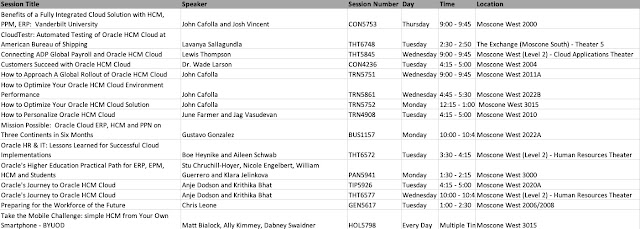
So that's my take on the 15 most interesting looking HCM Cloud Applications sessions at OOW 19.
One more thing: I'm hoping to meeting with lots of customers one-on-one. Especially those customers interested in Oracle HCM Cloud's mobile responsive Newsfeed UX or automated functional regression testing. If you're attending OOW 19 and you would like to meeting, ping me on Twitter @fteter and we can set up a meet. Hope to see you there!
Needless to say, the executive keynotes and the HCM Cloud Roadmap sessions are high points. For the most part, I won't be calling those out here even though I personally plan to make as many as I can.
For starters, note that I'll be hosting or co-hosting several sessions myself:

You'll note that the first two sessions have the same title. Here's a pro tip for OOW 19: look at the first three letters in the Session Number. TRN indicates a presentation, while CLS means more of a round-table discussion gathering. You'll see I'm mostly doing round-table discussions. And I'm pretty happy about that, as I prefer conversations over more structured presentations.
For the remaining list, I limited myself to the top 15 sessions that look good to me. Your interests may be different. And it's also worth stating explicitly that, while I'm an Oracle employee, my opinions and selections are strictly my own:


So that's my take on the 15 most interesting looking HCM Cloud Applications sessions at OOW 19.
One more thing: I'm hoping to meeting with lots of customers one-on-one. Especially those customers interested in Oracle HCM Cloud's mobile responsive Newsfeed UX or automated functional regression testing. If you're attending OOW 19 and you would like to meeting, ping me on Twitter @fteter and we can set up a meet. Hope to see you there!
What Looks Good To Me: Oracle OpenWorld 2019
As I write this, we're a week away from Oracle OpenWorld 2019. And, as always at OOW, there are a flood of sessions, events and gatherings that compete for your attention. So I thought I'd share some thoughts on what looks good to me. Keep in mind that my current focus is Oracle HCM Cloud Applications, so I'll be limiting my shared thoughts to that subject area.
Needless to say, the executive keynotes and the HCM Cloud Roadmap sessions are high points. For the most part, I won't be calling those out here even though I personally plan to make as many as I can.
For starters, note that I'll be hosting or co-hosting several sessions myself:
You'll note that the first two sessions have the same title. Here's a pro tip for OOW 19: look at the first three letters in the Session Number. TRN indicates a presentation, while CLS means more of a round-table discussion gathering. You'll see I'm mostly doing round-table discussions. And I'm pretty happy about that, as I prefer conversations over more structured presentations.
For the remaining list, I limited myself to the top 15 sessions that look good to me. Your interests may be different. And it's also worth stating explicitly that, while I'm an Oracle employee, my opinions and selections are strictly my own:
So that's my take on the 15 most interesting looking HCM Cloud Applications sessions at OOW 19.
One more thing: I'm hoping to meeting with lots of customers one-on-one. Especially those customers interested in Oracle HCM Cloud's mobile responsive Newsfeed UX or automated functional regression testing. If you're attending OOW 19 and you would like to meeting, ping me on Twitter @fteter and we can set up a meet. Hope to see you there!
Needless to say, the executive keynotes and the HCM Cloud Roadmap sessions are high points. For the most part, I won't be calling those out here even though I personally plan to make as many as I can.
For starters, note that I'll be hosting or co-hosting several sessions myself:
You'll note that the first two sessions have the same title. Here's a pro tip for OOW 19: look at the first three letters in the Session Number. TRN indicates a presentation, while CLS means more of a round-table discussion gathering. You'll see I'm mostly doing round-table discussions. And I'm pretty happy about that, as I prefer conversations over more structured presentations.
For the remaining list, I limited myself to the top 15 sessions that look good to me. Your interests may be different. And it's also worth stating explicitly that, while I'm an Oracle employee, my opinions and selections are strictly my own:
So that's my take on the 15 most interesting looking HCM Cloud Applications sessions at OOW 19.
One more thing: I'm hoping to meeting with lots of customers one-on-one. Especially those customers interested in Oracle HCM Cloud's mobile responsive Newsfeed UX or automated functional regression testing. If you're attending OOW 19 and you would like to meeting, ping me on Twitter @fteter and we can set up a meet. Hope to see you there!
New Admin Pages
As you all know, I've been deep into the new mobile responsive Newsfeed UX for Oracle HCM Cloud since last year. And, like most everything else in a continuous service delivery model, new features and functionality have been rolling out incremental with each new update. And the latest update, 19C, continues that trend.
One of the big changes in 19C is the uplift of administrative pages (aka professional landing pages) to the Newsfeed UX look and feel. It's coming to all users, regardless of whether you're still using the classic Simplified User Interface or the new mobile responsive Newsfeed UX. For customers still on the classic UI, this provides an opportunity to dip your toes in the water with Newsfeed UX without any configuration effort. For those customers already on Newsfeed UX, this makes the look and feel of the administrative pages consistent with all the other pages.
Here is a before and after screen shot example so you can get a feel for what I'm talking about:
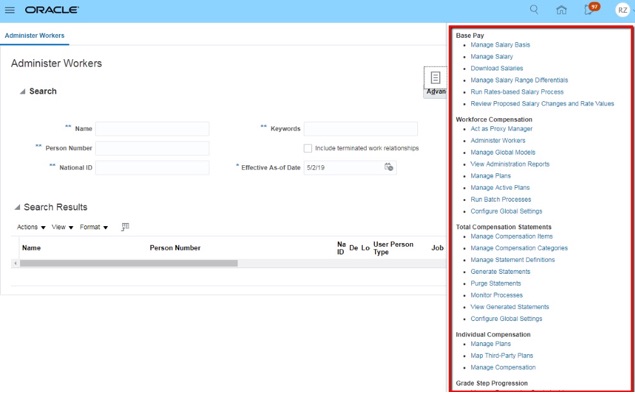
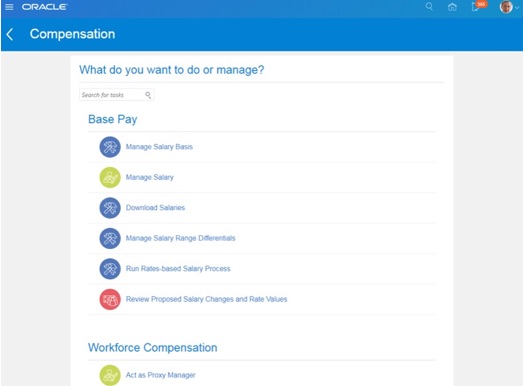
One of the big changes in 19C is the uplift of administrative pages (aka professional landing pages) to the Newsfeed UX look and feel. It's coming to all users, regardless of whether you're still using the classic Simplified User Interface or the new mobile responsive Newsfeed UX. For customers still on the classic UI, this provides an opportunity to dip your toes in the water with Newsfeed UX without any configuration effort. For those customers already on Newsfeed UX, this makes the look and feel of the administrative pages consistent with all the other pages.
Here is a before and after screen shot example so you can get a feel for what I'm talking about:
Before
After
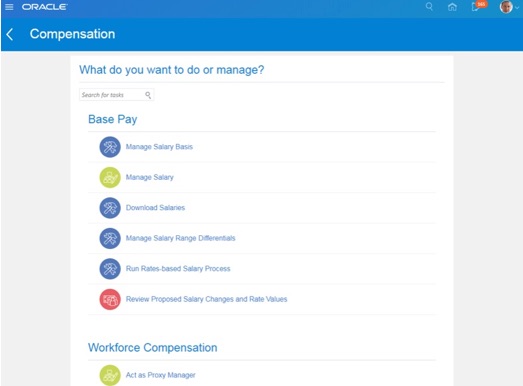
Personally, I've found that the Search feature at the top of the page in the new layout is really handy. I don't need to scroll or try other navigation - just search for what I need. Nice cool factor for ease of use.
This brings me to a really important point: if you are an Oracle HCM Cloud customer who has not switched to mobile responsive Newsfeed UX, I have to ask why not? It is Oracle's strategic direction going forward - we're releasing more and more new functionality that ties into Newsfeed UX. So the longer you wait, the further behind you fall on benefiting from that new functionality. Is that really where you want to be, burping and chirping behind the curve while the rest of your industry grabs the gains of those new features? Just a thought... you can always sound off with your own perspective in the comments.
New Admin Pages
As you all know, I've been deep into the new mobile responsive Newsfeed UX for Oracle HCM Cloud since last year. And, like most everything else in a continuous service delivery model, new features and functionality have been rolling out incremental with each new update. And the latest update, 19C, continues that trend.
One of the big changes in 19C is the uplift of administrative pages (aka professional landing pages) to the Newsfeed UX look and feel. It's coming to all users, regardless of whether you're still using the classic Simplified User Interface or the new mobile responsive Newsfeed UX. For customers still on the classic UI, this provides an opportunity to dip your toes in the water with Newsfeed UX without any configuration effort. For those customers already on Newsfeed UX, this makes the look and feel of the administrative pages consistent with all the other pages.
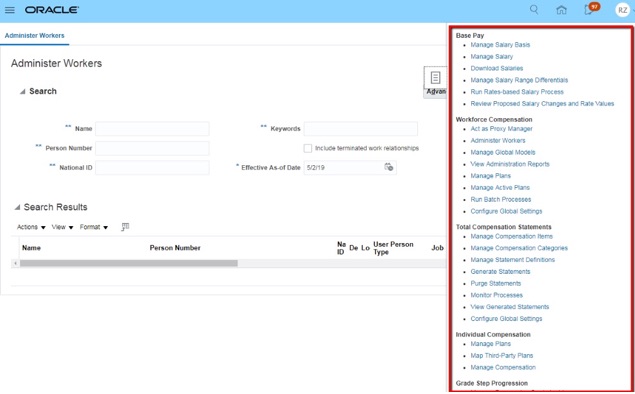
Here is a before and after screen shot example so you can get a feel for what I'm talking about:
One of the big changes in 19C is the uplift of administrative pages (aka professional landing pages) to the Newsfeed UX look and feel. It's coming to all users, regardless of whether you're still using the classic Simplified User Interface or the new mobile responsive Newsfeed UX. For customers still on the classic UI, this provides an opportunity to dip your toes in the water with Newsfeed UX without any configuration effort. For those customers already on Newsfeed UX, this makes the look and feel of the administrative pages consistent with all the other pages.
Here is a before and after screen shot example so you can get a feel for what I'm talking about:
Before
After
Personally, I've found that the Search feature at the top of the page in the new layout is really handy. I don't need to scroll or try other navigation - just search for what I need. Nice cool factor for ease of use.
This brings me to a really important point: if you are an Oracle HCM Cloud customer who has not switched to mobile responsive Newsfeed UX, I have to ask why not? It is Oracle's strategic direction going forward - we're releasing more and more new functionality that ties into Newsfeed UX. So the longer you wait, the further behind you fall on benefiting from that new functionality. Is that really where you want to be, burping and chirping behind the curve while the rest of your industry grabs the gains of those new features? Just a thought... you can always sound off with your own perspective in the comments.
The End Is Here
A little different from our usual fare here...
I'm a Mac user. Switched from Windows to OS X several years ago and never looked back. As time has passed, Apple has fallen behind on hardware design. There's no question that the Microsoft Surface line surpasses the MacBook line in terms of hardware elegance and utility. But I just can't bring myself to leave a rock solid operating system and run it back to Windows as my main operating system (I run both Windows and Linux VMs for when I absolutely have to do work with either).
I'm not alone in the Oracle ecosystem with my choice of OS X over Windows. I run into Apple users everyday. Usually they're more technical types, but I have run into a fair number of functional consultants and business end users on OS X. Heck, Oracle now even gives their employees the choice of a company-issued MacBook Pro.
For those of us running OS X (whether it relates to use of Oracle products or not), we face a major shift coming later this year. The end is here for 32-bit apps. When Apple issues the latest version of OS X, Catalina, 32-bit apps will stop working. Catalina will come out in September. Apple sounded the death knell in HighSierra with notices about 32-bit app future incompatibility with "not optimized" warnings:

So it's not like we didn't know it's coming. But still, like many others, it's arrived faster than I would like. I still rely on some 32-bit apps:
- Cisco AnyConnect - I use this VPN client every day in my work; I'm actually in VPN a majority of my work day.
- Text Wrangler - A wonderful, simple little text editor. Every week, I write a status report to my management using this app.
- Skype Meetings - I use this once or twice per week for customer virtual meetings.
I could go on, but the list is pretty extensive. And, again, I'm sure I'm not alone. To make things even stickier, many of these 32-bit apps do not have 64-bit replacements. So I'll have to somewhat change the way I work before up taking Catalina.
For those of you out there running OS X, there are a number of ways you can identify the 32-bit apps you're running. But the easiest is probably a free application called Go64 from St. Clair Software. The app scans your hard drive and identifies any 32-bit apps. Pretty handy - after all, the first step in changing behavior is admitting that you have a problem. And 32-bit apps on OS X are now a problem.
I can't even imagine the level of hurt for someone taking automatic updates who will wake up some fine morning early this fall and discover that mission-critical 32-bit apps no longer work because their operating system upgraded overnight (and you KNOW this will happen to someone - just don't let that someone be you). So between now and September, I'll be changing the way I work by moving off all my 32-bit apps. If you're an OS X user, you should be doing the same. For 32-bit apps, the end is here.
The End Is Here
A little different from our usual fare here...
I'm a Mac user. Switched from Windows to OS X several years ago and never looked back. As time has passed, Apple has fallen behind on hardware design. There's no question that the Microsoft Surface line surpasses the MacBook line in terms of hardware elegance and utility. But I just can't bring myself to leave a rock solid operating system and run it back to Windows as my main operating system (I run both Windows and Linux VMs for when I absolutely have to do work with either).
I'm not alone in the Oracle ecosystem with my choice of OS X over Windows. I run into Apple users everyday. Usually they're more technical types, but I have run into a fair number of functional consultants and business end users on OS X. Heck, Oracle now even gives their employees the choice of a company-issued MacBook Pro.
For those of us running OS X (whether it relates to use of Oracle products or not), we face a major shift coming later this year. The end is here for 32-bit apps. When Apple issues the latest version of OS X, Catalina, 32-bit apps will stop working. Catalina will come out in September. Apple sounded the death knell in HighSierra with notices about 32-bit app future incompatibility with "not optimized" warnings:
So it's not like we didn't know it's coming. But still, like many others, it's arrived faster than I would like. I still rely on some 32-bit apps:
- Cisco AnyConnect - I use this VPN client every day in my work; I'm actually in VPN a majority of my work day.
- Text Wrangler - A wonderful, simple little text editor. Every week, I write a status report to my management using this app.
- Skype Meetings - I use this once or twice per week for customer virtual meetings.
I could go on, but the list is pretty extensive. And, again, I'm sure I'm not alone. To make things even stickier, many of these 32-bit apps do not have 64-bit replacements. So I'll have to somewhat change the way I work before up taking Catalina.
For those of you out there running OS X, there are a number of ways you can identify the 32-bit apps you're running. But the easiest is probably a free application called Go64 from St. Clair Software. The app scans your hard drive and identifies any 32-bit apps. Pretty handy - after all, the first step in changing behavior is admitting that you have a problem. And 32-bit apps on OS X are now a problem.
I can't even imagine the level of hurt for someone taking automatic updates who will wake up some fine morning early this fall and discover that mission-critical 32-bit apps no longer work because their operating system upgraded overnight (and you KNOW this will happen to someone - just don't let that someone be you). So between now and September, I'll be changing the way I work by moving off all my 32-bit apps. If you're an OS X user, you should be doing the same. For 32-bit apps, the end is here.
The Old Bugaboo
So after a bit of a hiatus, I've decided it's time to get off my butt and start writing again...
Today I'm raising an old bugaboo, but I'm adding a new perspective. The bugaboo? Customizing packaged software. It's more expensive than either building your own apps from scratch or buying software off the shelve. But you all already know that because we've previously hashed that out at length here.
On to the new perspective. As many of you know, I've been up to my eyeballs in helping customers switch to the mobile responsive Newsfeed UX for Oracle's HCM Cloud Applications. And we're finding customers love it. The ease of use, the consistency of the user experience between mobile and desktop platforms, the overall look and feel, the short learning curve, the high levels of user acceptance smoothing the change management involved in the switch. Newsfeed UX is a huge hit. But I digress, so let me get back on track. We offer several tools for personalizing, extending and customizing this new user experience. Between the components of the HCM Experience Design Studio and Page Composer, customers can change the UX in pretty much any way their heart desires.
But just because you can do something doesn't mean you should do something. I'm seeing quite a few customers burn quite a few calories on customizations with relatively minor impact, mostly involving the user interface rather than the user experience. (What's the difference? The user interface is about the look and feel. The user experience is about the way you work. The latter has a much broader and more meaningful impact than the former.) Changing the color of the text in a button. Removing the category title from an event. Substituting a seeded icon for one of their own design. To sum up... making big efforts to change minor details, things that don't impact the ability to conduct critical business processes or provide meaningful business intelligence.
Changing minor UI details, in and of itself, is not so bad. I often think the energy expended is over the top in comparison to the return. But if it is important enough to a customer to burn their resources in that way, that is their choice to make. But the thing so few realize when implementing these changes is the cost going forward. That cost comes in testing and maintaining those customizations as part of each and every system configuration change. A new patch is applied? Better test our customizations. Implementing a new interface? Better test our customizations. A new release or update? Better test our customizations. And, by the way, redesign and reapply those customizations as needed. A change in application architecture? We need to redesign and reapply those customizations. Start thinking about the frequency of these and similar cases, then consider the resources involved. You'll get the idea.
One more time: just because you can do something doesn't really mean you should do something. Are there times when customizing is the right choice? Of course. If a customization is necessary in order for you to execute a critical business process using packaged apps or services, then that is what you do. Just consider it carefully first. Because the old bugaboo of customization is the gift that just keeps on taking.
Today I'm raising an old bugaboo, but I'm adding a new perspective. The bugaboo? Customizing packaged software. It's more expensive than either building your own apps from scratch or buying software off the shelve. But you all already know that because we've previously hashed that out at length here.
On to the new perspective. As many of you know, I've been up to my eyeballs in helping customers switch to the mobile responsive Newsfeed UX for Oracle's HCM Cloud Applications. And we're finding customers love it. The ease of use, the consistency of the user experience between mobile and desktop platforms, the overall look and feel, the short learning curve, the high levels of user acceptance smoothing the change management involved in the switch. Newsfeed UX is a huge hit. But I digress, so let me get back on track. We offer several tools for personalizing, extending and customizing this new user experience. Between the components of the HCM Experience Design Studio and Page Composer, customers can change the UX in pretty much any way their heart desires.
But just because you can do something doesn't mean you should do something. I'm seeing quite a few customers burn quite a few calories on customizations with relatively minor impact, mostly involving the user interface rather than the user experience. (What's the difference? The user interface is about the look and feel. The user experience is about the way you work. The latter has a much broader and more meaningful impact than the former.) Changing the color of the text in a button. Removing the category title from an event. Substituting a seeded icon for one of their own design. To sum up... making big efforts to change minor details, things that don't impact the ability to conduct critical business processes or provide meaningful business intelligence.
Changing minor UI details, in and of itself, is not so bad. I often think the energy expended is over the top in comparison to the return. But if it is important enough to a customer to burn their resources in that way, that is their choice to make. But the thing so few realize when implementing these changes is the cost going forward. That cost comes in testing and maintaining those customizations as part of each and every system configuration change. A new patch is applied? Better test our customizations. Implementing a new interface? Better test our customizations. A new release or update? Better test our customizations. And, by the way, redesign and reapply those customizations as needed. A change in application architecture? We need to redesign and reapply those customizations. Start thinking about the frequency of these and similar cases, then consider the resources involved. You'll get the idea.
One more time: just because you can do something doesn't really mean you should do something. Are there times when customizing is the right choice? Of course. If a customization is necessary in order for you to execute a critical business process using packaged apps or services, then that is what you do. Just consider it carefully first. Because the old bugaboo of customization is the gift that just keeps on taking.
The Old Bugaboo
So after a bit of a hiatus, I've decided it's time to get off my butt and start writing again...
Today I'm raising an old bugaboo, but I'm adding a new perspective. The bugaboo? Customizing packaged software. It's more expensive than either building your own apps from scratch or buying software off the shelve. But you all already know that because we've previously hashed that out at length here.
On to the new perspective. As many of you know, I've been up to my eyeballs in helping customers switch to the mobile responsive Newsfeed UX for Oracle's HCM Cloud Applications. And we're finding customers love it. The ease of use, the consistency of the user experience between mobile and desktop platforms, the overall look and feel, the short learning curve, the high levels of user acceptance smoothing the change management involved in the switch. Newsfeed UX is a huge hit. But I digress, so let me get back on track. We offer several tools for personalizing, extending and customizing this new user experience. Between the components of the HCM Experience Design Studio and Page Composer, customers can change the UX in pretty much any way their heart desires.
But just because you can do something doesn't mean you should do something. I'm seeing quite a few customers burn quite a few calories on customizations with relatively minor impact, mostly involving the user interface rather than the user experience. (What's the difference? The user interface is about the look and feel. The user experience is about the way you work. The latter has a much broader and more meaningful impact than the former.) Changing the color of the text in a button. Removing the category title from an event. Substituting a seeded icon for one of their own design. To sum up... making big efforts to change minor details, things that don't impact the ability to conduct critical business processes or provide meaningful business intelligence.
Changing minor UI details, in and of itself, is not so bad. I often think the energy expended is over the top in comparison to the return. But if it is important enough to a customer to burn their resources in that way, that is their choice to make. But the thing so few realize when implementing these changes is the cost going forward. That cost comes in testing and maintaining those customizations as part of each and every system configuration change. A new patch is applied? Better test our customizations. Implementing a new interface? Better test our customizations. A new release or update? Better test our customizations. And, by the way, redesign and reapply those customizations as needed. A change in application architecture? We need to redesign and reapply those customizations. Start thinking about the frequency of these and similar cases, then consider the resources involved. You'll get the idea.
One more time: just because you can do something doesn't really mean you should do something. Are there times when customizing is the right choice? Of course. If a customization is necessary in order for you to execute a critical business process using packaged apps or services, then that is what you do. Just consider it carefully first. Because the old bugaboo of customization is the gift that just keeps on taking.
Today I'm raising an old bugaboo, but I'm adding a new perspective. The bugaboo? Customizing packaged software. It's more expensive than either building your own apps from scratch or buying software off the shelve. But you all already know that because we've previously hashed that out at length here.
On to the new perspective. As many of you know, I've been up to my eyeballs in helping customers switch to the mobile responsive Newsfeed UX for Oracle's HCM Cloud Applications. And we're finding customers love it. The ease of use, the consistency of the user experience between mobile and desktop platforms, the overall look and feel, the short learning curve, the high levels of user acceptance smoothing the change management involved in the switch. Newsfeed UX is a huge hit. But I digress, so let me get back on track. We offer several tools for personalizing, extending and customizing this new user experience. Between the components of the HCM Experience Design Studio and Page Composer, customers can change the UX in pretty much any way their heart desires.
But just because you can do something doesn't mean you should do something. I'm seeing quite a few customers burn quite a few calories on customizations with relatively minor impact, mostly involving the user interface rather than the user experience. (What's the difference? The user interface is about the look and feel. The user experience is about the way you work. The latter has a much broader and more meaningful impact than the former.) Changing the color of the text in a button. Removing the category title from an event. Substituting a seeded icon for one of their own design. To sum up... making big efforts to change minor details, things that don't impact the ability to conduct critical business processes or provide meaningful business intelligence.
Changing minor UI details, in and of itself, is not so bad. I often think the energy expended is over the top in comparison to the return. But if it is important enough to a customer to burn their resources in that way, that is their choice to make. But the thing so few realize when implementing these changes is the cost going forward. That cost comes in testing and maintaining those customizations as part of each and every system configuration change. A new patch is applied? Better test our customizations. Implementing a new interface? Better test our customizations. A new release or update? Better test our customizations. And, by the way, redesign and reapply those customizations as needed. A change in application architecture? We need to redesign and reapply those customizations. Start thinking about the frequency of these and similar cases, then consider the resources involved. You'll get the idea.
One more time: just because you can do something doesn't really mean you should do something. Are there times when customizing is the right choice? Of course. If a customization is necessary in order for you to execute a critical business process using packaged apps or services, then that is what you do. Just consider it carefully first. Because the old bugaboo of customization is the gift that just keeps on taking.
Bits And Pieces
Lots of innovative change afoot in the Oracle HCM Cloud space, so I thought I'd catch y'all up on the more significant bits and pieces.
- Enhanced Talent Profiles: Oracle Recruiting Cloud ("ORC") and Oracle Learning Cloud ("OLC")customers must upgrade to Enhanced Talent Profiles as part of their 19A uptake. See My Oracle Support Doc ID 2421964.1 "Upgrading Fusion Profile Management" for more info. This is a really cool upgrade for the ORC and OLC customers - you'll want to jump on this one.
- ORC customers: must switch to Newsfeed UX as the first step in upgrading to Enhanced Talent Profiles. This essentially means that ORC requires a switch to Newsfeed UX and an upgrade to Enhanced Talent Profiles as part of the 19A uptake in order for the app to function going forward. Double benefits here: a mobile responsive UI and the Enhanced Talent Profiles!
- File Based Loader: File Based Loader ("FBL") will not be supported as of update 19B (which begins to roll out to HCM Cloud customers in May). Last I looked, there were still a small set of customers using FBL. If you're one of those customers, may I suggest that you make the move to the more powerful HCM Data Loader ("HDL") now?
- Newsfeed UX: It seems that Newsfeed UX may become the default with the 20A update, which is due begin rolling out in February 2020. But, in the meantime, we're seeing new and very cool functionality appear that only works in Newsfeed UX - with more on the short term horizon. So the longer you wait to switch, the further behind you'll fall. So the question is not "when will Newsfeed UX become the default", but "how soon can we switch to Newsfeed UX?" I recently had a customer tell me switching to Newsfeed UX "...is the best thing we've ever done for our users!" So what are you waiting for?
We have some additional innovation goodies on the verge of coming out, but I'm not at liberty to discuss those yet (one of the very few downsides to this job). But I can say that sine of those goodies depend on you taking up the changes listed here. So roll up your sleeves and get going - we have lots of cool innovation available and in the pipeline, but it doesn't do you any good until you take it up!
Bits And Pieces
Lots of innovative change afoot in the Oracle HCM Cloud space, so I thought I'd catch y'all up on the more significant bits and pieces.
- Enhanced Talent Profiles: Oracle Recruiting Cloud ("ORC") and Oracle Learning Cloud ("OLC")customers must upgrade to Enhanced Talent Profiles as part of their 19A uptake. See My Oracle Support Doc ID 2421964.1 "Upgrading Fusion Profile Management" for more info. This is a really cool upgrade for the ORC and OLC customers - you'll want to jump on this one.
- ORC customers: must switch to Newsfeed UX as the first step in upgrading to Enhanced Talent Profiles. This essentially means that ORC requires a switch to Newsfeed UX and an upgrade to Enhanced Talent Profiles as part of the 19A uptake in order for the app to function going forward. Double benefits here: a mobile responsive UI and the Enhanced Talent Profiles!
- File Based Loader: File Based Loader ("FBL") will not be supported as of update 19B (which begins to roll out to HCM Cloud customers in May). Last I looked, there were still a small set of customers using FBL. If you're one of those customers, may I suggest that you make the move to the more powerful HCM Data Loader ("HDL") now?
- Newsfeed UX: It seems that Newsfeed UX may become the default with the 20A update, which is due begin rolling out in February 2020. But, in the meantime, we're seeing new and very cool functionality appear that only works in Newsfeed UX - with more on the short term horizon. So the longer you wait to switch, the further behind you'll fall. So the question is not "when will Newsfeed UX become the default", but "how soon can we switch to Newsfeed UX?" I recently had a customer tell me switching to Newsfeed UX "...is the best thing we've ever done for our users!" So what are you waiting for?
We have some additional innovation goodies on the verge of coming out, but I'm not at liberty to discuss those yet (one of the very few downsides to this job). But I can say that sine of those goodies depend on you taking up the changes listed here. So roll up your sleeves and get going - we have lots of cool innovation available and in the pipeline, but it doesn't do you any good until you take it up!
Listening To Customers
The Oracle HCM Cloud team hosted their annual Customer Advisory Board meetings at Oracle HQ last week. I've always enjoyed the CAB meetings because it's the one event where we reverse the flow of information: customers tell us about how they use our products rather than us showing customers how to use those products. I learned a few lessons in listening to our customers last week.
Customers today are more concerned with the pragmatic aspects of AI
Innovation is cool, but customers want to know more about optimizing what they have now
Mobile - Finally!
Functional regression testing has become a bottleneck
Customers today are more concerned with the pragmatic aspects of AI
To be honest, I went to the CAB meetings prepared to talk about the innovative projects happening around AI: quantum computing, artificial decision-making, responsive vs structured chatbots. But our customers wanted to talk about the pragmatic aspects of AI, especially robotic process automation. I ended the week feeling that I'd been prepared to talk about running while our customers are still focused on learning to walk.
Surprisingly, most of my one-to-one conversations with customers were not about upcoming new features. Instead, the dominant theme was about their hunger to better use the features they already have in hand. "How can I make better use of..." or "How can I meet the challenge of... when I get back to the office on Monday."
You've heard the message for years: "If you ain't got mobile, you ain't got nothing." 2019 is the year that our Oracle HCM Cloud customers are moving out on that idea. About 20 percent of the customers attending the CAB meetings had gone mobile with their self-service HCM apps in the prior six months. Everyone else... and I do mean everyone else... is planning to go mobile in 2019. So the party has been a little slow in getting started, but it's really catching fire now. Different approaches to the self-service mobile user experience was a hot topic.
Now that continuous service delivery is a reality, functional regression testing has become a bottleneck. The classic approach of fully manual, end-to-end functional regression testing simply does not meet the schedule requirements of a continuous service delivery model - just not enough time. Customers had serious energy around regression testing strategies as well as automated testing tools - they're compelled to change and are still figuring out just how to change. Interesting side note - we also heard some overlap here with the interest in robotic process automation.
So those were the customer messages I took away from the CAB meetings. I'll wager others heard different things, but this is what I got out of the meetings. So now I've got some new ideas regarding my own work agenda for 2019 - how can I help in some small way to bring direction and clarity by responding to what I heard? Stay tuned for more.
Listening To Customers
The Oracle HCM Cloud team hosted their annual Customer Advisory Board meetings at Oracle HQ last week. I've always enjoyed the CAB meetings because it's the one event where we reverse the flow of information: customers tell us about how they use our products rather than us showing customers how to use those products. I learned a few lessons in listening to our customers last week.
Customers today are more concerned with the pragmatic aspects of AI
Innovation is cool, but customers want to know more about optimizing what they have now
Mobile - Finally!
Functional regression testing has become a bottleneck
Customers today are more concerned with the pragmatic aspects of AI
To be honest, I went to the CAB meetings prepared to talk about the innovative projects happening around AI: quantum computing, artificial decision-making, responsive vs structured chatbots. But our customers wanted to talk about the pragmatic aspects of AI, especially robotic process automation. I ended the week feeling that I'd been prepared to talk about running while our customers are still focused on learning to walk.
Surprisingly, most of my one-to-one conversations with customers were not about upcoming new features. Instead, the dominant theme was about their hunger to better use the features they already have in hand. "How can I make better use of..." or "How can I meet the challenge of... when I get back to the office on Monday."
You've heard the message for years: "If you ain't got mobile, you ain't got nothing." 2019 is the year that our Oracle HCM Cloud customers are moving out on that idea. About 20 percent of the customers attending the CAB meetings had gone mobile with their self-service HCM apps in the prior six months. Everyone else... and I do mean everyone else... is planning to go mobile in 2019. So the party has been a little slow in getting started, but it's really catching fire now. Different approaches to the self-service mobile user experience was a hot topic.
Now that continuous service delivery is a reality, functional regression testing has become a bottleneck. The classic approach of fully manual, end-to-end functional regression testing simply does not meet the schedule requirements of a continuous service delivery model - just not enough time. Customers had serious energy around regression testing strategies as well as automated testing tools - they're compelled to change and are still figuring out just how to change. Interesting side note - we also heard some overlap here with the interest in robotic process automation.
So those were the customer messages I took away from the CAB meetings. I'll wager others heard different things, but this is what I got out of the meetings. So now I've got some new ideas regarding my own work agenda for 2019 - how can I help in some small way to bring direction and clarity by responding to what I heard? Stay tuned for more.